


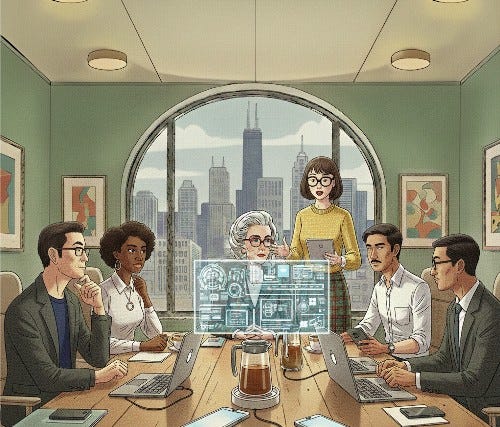
For the first time in labour history, six generations are working alongside one another. Not in theory, but in the lived reality of conference rooms, Slack channels, Zoom calls, and hybrid meetings where a Silent Generation board chair (70+ yrs old) may be listening to a Gen Z (~24 yr old) analyst explaining the nuances of an AI model. This coexistence is the natural consequence of longer lives, greater health span, and longer careers. In some cases, people work for sixty-plus years—an unimaginable span half a century ago.
Despite an abundance of perspective and talent in multi-generational organizations, they often struggle to translate this into collective strength. In an era where a junior employee may have more technical expertise than a senior leader, authority itself becomes contested terrain. Also, familiar and unhelpful stereotypes flow easily as executives assume younger employees are entitled and lack drive; younger employees accuse leadership of stagnation. Communication styles can clash: formal emails versus rapid-fire chats, and scheduled meetings versus asynchronous updates. The source of friction is not merely cultural; it is operational. It slows decision-making, erodes trust, and creates blind spots in strategy.
A gap in connectivity is easy to see and leaves abundant opportunity to grow stronger and more competitive as an organization. Each generation brings unique value, perspectives, and experiences. Collaboration and real exploration of the many unique viewpoints is required in order to make an organization truly innovative, efficient, and resilient. The leaders in the organization hold the responsibility to create and reinforce these intentional structures that help all generations understand, learn from, and leverage one another.
Moving from friction to flow requires a shift in posture—from judgment to respect; from siloed expertise to shared intelligence; from senior monopoly on wisdom to an intellectual meritocracy; embracing fresh perspectives at all levels.
The rise of AI makes this shift even more urgent. Younger generations often speak the language of emerging technologies with native fluency, while older generations hold the tacit knowledge of how organizations actually function. One understands the tools; the other, the terrain. When these two types of knowledge meet, companies gain a rare advantage: the ability to innovate without losing their footing; Products become more attuned to the full spectrum of consumers, from high-net-worth Boomers to digitally native Gen Z buyers. Strategies become more resilient because they draw on both historical pattern recognition and future-oriented experimentation.
Organizations can bridge the generational divide by fostering intentional interactions: cross-generational project teams, for example, or reverse-mentorship programs where younger employees teach digital fluency and older colleagues offer organizational navigation. Injecting diverse perspectives into traditionally closed-door meetings like investment deal meetings, credit committees, clinical trial go/no-go meetings, or strategic retreats, goes a long way in breaking down generational layers. Creating shared learning opportunities or inter-generational collaboration sessions can also foster collective growth. Making explicit each person’s preferred communication channel (Slack, text, email, Zoom) can also improve clarity and connection. Above all, to succeed, organizations must embrace a culture of grace—have patience with each other, seek to understand, appreciate differences, share knowledge willingly, and hold humanity at heart.
The “so what” for companies is not abstract. Intergenerational fluency is a risk-mitigation strategy. Organizations that master it become more adaptable, more attractive to talent, and more compelling to investors. They reduce turnover, preserve institutional memory, accelerate innovation, and build cultures where people actually enjoy working. In a world defined by volatility, the organizations that thrive will be those that treat their multi-generational team as an asset to be orchestrated. Diversity of age, like any form of diversity, makes the world more interesting—and the enterprise more resilient.